
Growing resilience: Associate Professor Antonios Petridis wants to secure the future of fruit production
Antonios Petridis, newly appointed Associate Professor at the Department of Food Science at Aarhus University (AU FOOD), whispers the secret language of plants – and believes in persevering as a reseacher in a field that struggles.

When Associate Professor Antonios Petridis talks about plants, he speaks about them almost as if they were people.
”They need to communicate”, he says. ”When a plant experiences drought, the roots have to tell the leaves there’s a problem. They have to work together to survive."
For him, this invisible conversation inside a plant is more than a fascinating biological process. It is the key to understanding one of society’s biggest challenges: producing enough nutritious food in a world shaped by climate change, limited resources and growing uncertainty.
For Antonios Petridis, becoming an Associate Professor at the Department of Food Science at Aarhus University (AU FOOD) is not a finish line – it is a natural next step in a career driven by curiosity, perseverance, and a commitment to making food production more resilient.
”I don’t see it as a surprise”, he says about his recent transition from Tenure Track to Associate Professor. ”It feels like a natural progression of something I have worked towards throughout my career.”
That journey has taken him from the warm winds of Greece to Germany, the UK and eventually Denmark, where he has established his own research group and completed the demanding Tenure Track programme at Aarhus University. Along the way, one thing has remained constant: a fascination with understanding how plants work – and how that knowledge can help solve real-world challenges.
Fascinated by how plants communicate
Antonios’ scientific curiosity started early. Growing up in Greece in an academic family with a mother who’s a professor in Biology of Horticultural crops, research was never something distant. It was part of everyday life. ”I was always attracted by academia”, he says. ”I like the research, the problems we’re trying to solve, and how we go about solving them. I think there’s beauty in it.”
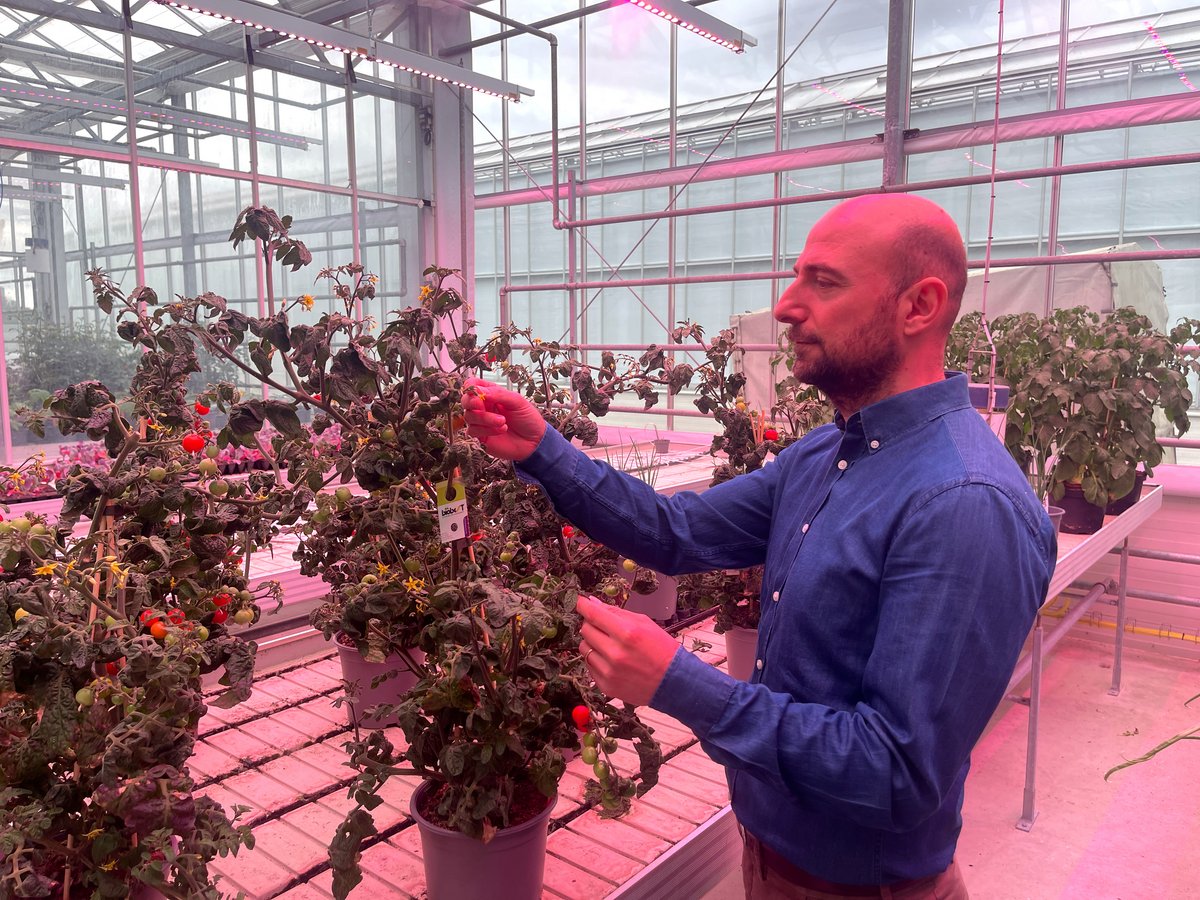
Today, his work focuses on one of the questions he finds most exciting: how different parts of a plant communicate when faced with environmental stress.
”When people are thirsty, they simply go to drink water. But unlike humans, plants can’t move. They have to sense what’s happening around them and communicate internally so they can survive,” Antonios explains.
Understanding these biological signaling pathways may seem highly fundamental, but for Antonios they are also the foundation for practical solutions. By understanding how plants respond to drought, heat and other stressors, researchers can develop crops that are more resilient, productive and better suited for a changing climate.
Research that reaches beyond the laboratory
For Antonios, excellent research is never an end in itself. His ambition is to translate fundamental discoveries into solutions that benefit growers and society.
”My goal is to improve productivity, fruit quality and resilience, while giving growers the tools they need to produce more efficiently and more sustainably,” he says.
His research addresses challenges that are becoming increasingly urgent. Climate change, pressure on natural resources and the need for food security all demand new approaches to crop production. At the same time, Danish fruit growers face rising production costs, labour shortages and international competition.
Rather than seeing these challenges as reasons to move into a more fashionable research field, Antonios has chosen to stay committed.
”I believe fruit production needs our support. If anything, the challenges make me even more motivated to contribute.”
Looking ahead, he sees enormous potential in combining plant physiology with technologies such as automation, robotics and controlled-environment agriculture to strengthen sustainable food production.
Building independence through perseverance
For Antonios, the transition from Tenure Track to Associate Professor has been both professionally rewarding and personally demanding: ”It was one of the most intense periods of my life”, he says with a smile and a sigh of relief uttered at the same time.
Establishing an independent research program while securing funding was one of the biggest challenges, particularly in a research area that receives less attention than larger agricultural sectors. His response was simple: keep going. ”I believe in perseverance. You learn from the feedback, improve your ideas and apply again”, he says.
That determination has shaped not only his career but also his outlook on research: ”Good things come with hard work. Sometimes success takes time, but eventually it comes.”
When asked how he deals with the stress, pressure and uncertainty that also comes with a highly succesful scientific career, Antonios stalls for a moment. ”The most important thing throughout the whole journey has been my family. For me, they have been the source of my tranquility in trying times”, he says with a soft smile.
”Playing Legos with my son, reading, playing the guitar – those are things that make pressure manageable. A little stress is fine, but keeping a balance is key.”

A vision for the future
As an Associate Professor, Antonios hopes to continue expanding both his research group and the impact of its work. His long-term vision is to bridge the gap between fundamental plant science and practical applications that growers can use directly in the field. ”If I see our research being applied in practice, I will consider it a success”, he says.
Beyond scientific advances, he also hopes to raise awareness of the importance of fruit and vegetable production – not only for Denmark’s food security, but also for public health and environmental sustainability.
He envisions a future where researchers, growers, policymakers and consumers work together to create more resilient production systems: ”We all have a role to play”, as Antonios frames it himself.
Energized by people
Although research is at the heart of his career, Antonios draws just as much energy from teaching and mentoring. Every lecture, he says, reminds him why academia matters: ”When I leave the classroom, I feel revitalized.”
Helping students understand why their studies matter – and not simply transferring knowledge – is at the heart of academic life for Antonios. That people-centered approach also shapes how he leads his research group.
He hopes to build an environment where talented young researchers can thrive, stay curious and find genuine satisfaction in their work.
When asked what drives him beyond publications, grants and recognition, his answer is crystal clear, immediate, and completely unrelated to science itself: ”People.”
And when asked what advice he would give young researchers beginning their own careers, his answer is equally concise: ”Work hard, work calm, persevere, and be kind. Then, amazing things will happen.”
Fact box
Name: Antonios Petridis
Title: Associate Professor at the Department of Food Science, Aarhus University (AU FOOD)
Age: 45
Lives in: Beder, Denmark
Origin: Greece
Education
- MSc in Horticultural Sciences
- PhD in Plant Physiology
Previous positions
- Postdoctoral Researcher at Leibniz Institute of Plant Genetics and Crop Plant Research (IPK Gatersleben), Germany
- Postdoctoral Researcher at the James Hutton Institute, United Kingdom
Research focus
Antonios' research explores how plants sense and respond to environmental stresses, with the goal of protecting fruit crops and strengthening the resilience, quality, and sustainability of Danish fruit production. By translating this understanding into practical solutions, his work aims to enhance the efficiency and competitiveness of the sector while advancing sustainable food production.