
What if the next breakthrough in wheat breeding happens below ground?
Beneath every wheat field is a busy world of tiny organisms. Now, AU FOOD Associate Professor Ivan Paponov and his international research team want to find out whether wheat can send them biological signals – and whether those signals could help crops use nutrients more efficiently and cope better with drought.

What if wheat could ask for help?
If you look at a wheat field, it is easy to imagine that not much is happening. The plants stand quietly in the soil. They grow, turn green, produce grain and wait for harvest. But underneath the surface, it is a completely different story.
The roots are surrounded by millions of microorganisms. Some of these tiny organisms can help plants access nutrients, while others may help them cope with difficult conditions.
And the plant is not simply sitting there passively. Its roots release substances that influence the microorganisms living around them. So, in a way, the plant and the microorganisms may be talking to each other. But what does that even mean?
That is the starting point for a new European research project called EVOLVE, led by Associate Professor Ivan Paponov from Aarhus University’s Department of Food Science (AU FOOD) and his team of researchers.
Together, they want to understand this interaction – and find out whether it could eventually help wheat use nutrients more efficiently and cope better with drought and other environmental stresses.
Tiny packages carrying messages
Plants release many different substances through their roots. EVOLVE is particularly interested in one possible way that plants send biological signals: tiny particles called ’extracellular vesicles’.
The name sounds complicated. But the basic idea is easier to understand: “Think of them as small packages,” Ivan explains. ”They are enclosed by a membrane and can carry biological molecules such as small RNAs.” The researchers will investigate whether small RNAs carried by these vesicles can influence specific microorganisms around the roots – and whether those microorganisms respond in ways that benefit the plant.
These are some of the questions Ivan and his team will explore in EVOLVE.
It started with a simple question
The idea behind EVOLVE did not begin as a grand research plan. It started with a question.
Ivan was already studying substances released from plant roots. He was also interested in the small vesicles involved in transporting biological material within plant cells. Then the two areas of research came together in his mind, and produced a question: Could some of the substances released by roots be packaged into these tiny vesicles and transported out of the roots?
“It sounded a little unusual at first, but that was also what made it so interesting,” Ivan says.
He discussed the idea with a colleague who was studying extracellular vesicles in pollen. The response was simple: Why not investigate it?
That conversation eventually grew into a larger collaboration. Step by step, more researchers joined, the idea developed and the project was ultimately selected for funding by the European Union.
Today, eight organizations in seven countries are working together on EVOLVE for the next three years.
What if we could breed plants that are better at teamwork?
This is where the idea could become particularly interesting for agriculture.
Plant breeders normally select plants for characteristics such as high yield, good quality or the ability to cope with drought and other stresses. But what if breeders could also look at how a plant interacts with the microorganisms around its roots?
Different wheat genotypes may produce different biological signals. Some plants might be better than others at influencing microorganisms in ways that improve nutrient use or help the plant cope with stress.
EVOLVE will investigate whether such differences exist and whether they could eventually be useful in plant breeding. Instead of selecting a plant only for what it can do on its own, breeders might one day also be able to consider how well it interacts with the microorganisms around its roots.
“For us, this opens up an exciting new opportunity for plant breeding,” says Ivan. But first, the researchers need to establish whether the idea works.
Could microorganisms help wheat use less fertilizer?
One of the big questions in EVOLVE is nitrogen. Wheat needs nitrogen to grow, and farmers currently supply much of it through fertilizer. But plants do not take up all the nitrogen that is added to the soil. Some is lost to the environment.
But what if microorganisms could help wheat access more of the nutrients that are already available?
Some microorganisms around plant roots can contribute to nutrient availability. EVOLVE will investigate whether wheat can influence these microorganisms – and whether extracellular vesicles and the biological molecules they carry play a role.
If the researchers can understand and eventually make use of these interactions, it could help develop crops that use nutrients more efficiently.
The project is also investigating algae-based biofertilizers. The idea is not simply to add nutrients to the soil. The researchers will explore whether algae could provide extracellular vesicles and other biological signals that influence microorganisms around plant roots.
In other words, could a biofertilizer do more than feed the plant? Could it also help influence the microscopic community around the roots? That is something the researchers will have to test.
And what about drought?
The researchers are also interested in what happens when water becomes scarce.
Some microorganisms around plant roots are known to help plants cope with drought. EVOLVE will investigate whether extracellular vesicles released by wheat, and the biological molecules they carry, can influence these beneficial microorganisms.
If the researchers find that they can, this could point towards a new way of helping plants make better use of their natural relationships with microorganisms when conditions become stressful.
In the longer term, the researchers hope this knowledge could contribute to identifying wheat plants that maintain yield and quality better under difficult conditions. But there is a long way to go before that becomes an agricultural technology.
From an intriguing idea to scientific evidence
EVOLVE is exploring a relatively new area of research, and the researchers do not yet know whether the mechanism they are investigating will work in the way they hope.
First, they need to understand what signals the plants produce, how those signals work and which microorganisms respond to them. They also need to find out whether different wheat genotypes differ enough for these interactions to become useful in plant breeding.
The project will begin with 48 different wheat genotypes. The researchers will investigate whether their methods can eventually be scaled up to much larger numbers of plants. Artificial intelligence will also be part of the project, helping the researchers analyze large amounts of biological data and look for patterns.
The aim is not to assume that the idea works, but to find out whether it works, how it works and whether it could eventually be useful.
Many years of research come together
For Ivan, EVOLVE also brings together many different strands of his scientific career.
Over the years, he has worked on plant breeding, plant nutrition, nitrogen use, molecular biology and bioinformatics. He has also studied the tiny vesicles involved in transport within plant cells and the substances plants release into their surroundings. Now, these different areas are coming together in one project.
“In a way, it feels like many years of research are coming together here,” he says.
Over the next three years, Ivan and his international team will try to work out what is really happening beneath the wheat field. Are plants sending biological messages? Are microorganisms responding? And, perhaps most importantly, can we help wheat make better use of these relationships?
The answers are not known yet. But if the researchers can demonstrate that these interactions work as they suspect, it could give plant breeders a new tool – and potentially offer a new way of thinking about sustainable agriculture. If successful, EVOLVE could open a new approach to crop improvement: looking not only at the plant itself, but also at how effectively it interacts with the microorganisms around its roots.
About Ivan A. Paponov
About Ivan A. Paponov
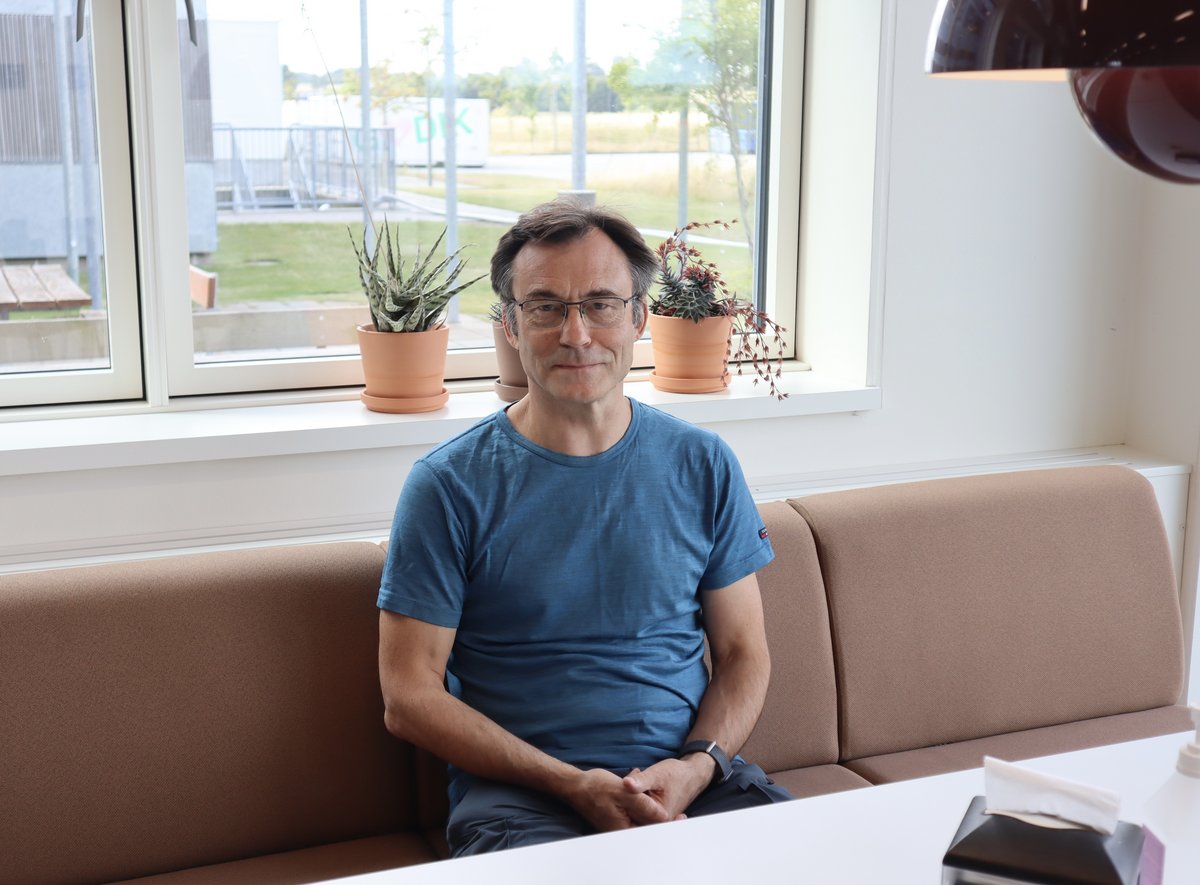
Name: Ivan A. Paponov
Age: 61
Lives: Tilst, Aarhus
Citizenship: German
Born: Perm, in the Ural Mountains, Russia
Title: Associate Professor at the Department of Food Science, Aarhus University
Role in EVOLVE: Coordinator of the EU-funded research project EVOLVE – “Translating Extracellular Vesicle Communication into AI-Guided Breeding and Smart Biofertilization”. The project has a budget of EUR 4.27 million and runs for 36 months from 2026. Aarhus University coordinates the project.
Research focus: Plant nutrition and plant responses to stress. His research focuses, among other things, on identifying plants with high nutrient-use efficiency and greater resilience to stress – knowledge that can be applied to future plant breeding. He also works on optimizing light and nutrient supply in greenhouses as well as in hydroponic and aeroponic growing systems.
Education: Habilitation in Plant Physiology from the University of Freiburg, Germany (2011); PhD in Biology from Timiryazev Agricultural Academy, Moscow (1992); and an MSc in Pomology and Viticulture from the same institution (1987).
Publications: More than 65 peer-reviewed scientific publications
Citations: More than 8,500
h-index: 30
ORCID: 0000-0002-2138-0722
Scientific Declaration
Scientific Declaration
Collaborators:
The EVOLVE consortium – eight partners in seven countries, coordinated by Aarhus University: Aarhus University (AU), Denmark (coordinator); Tel-Hai Academic College (TEL-HAI), Israel; Instytut Hodowli i Aklimatyzacji Roslin – Panstwowy Instytut Badawczy (IHAR), Poland; Universität für Bodenkultur Wien (BOKU), Austria; Technische Universität München (TUM), Germany; Agencia Estatal Consejo Superior de Investigaciones Científicas (CSIC), Spain; Alganize GmbH (ALGA), Germany; Microfluidics Innovation Center (MIC), France.
Potential conflicts of interest:
None.
Further information:
EVOLVE is funded by the European Union under Horizon Europe, EIC Pathfinder Challenges (grant agreement no. 101307269) and administered by the European Innovation Council and SMEs Executive Agency (EISMEA). The project has a budget of EUR 4,268,983 and runs for 36 months.
Relevant publication:
Paponov, I.A., Schulz, S., Schloter, M., Conesa, A., Leshem, Y. (2025). Extracellular vesicles in the rhizosphere: targets to improve nutrient use efficiency of crops? Frontiers in Plant Science 16, 1681793.
EVOLVE project website:
Currently under construction.
Contact:
Associate Professor
Ivan A. Paponov, Department of Food Science, Aarhus University
E-mail: ivpa@food.au.dk, Phone: +45 20 98 60 16
Science Communicator & Journalist
Kimie Kongsøre, Department of Food Science, Aarhus University
E-mail: kiko@food.au.dk, Phone: +45 20 84 43 63